
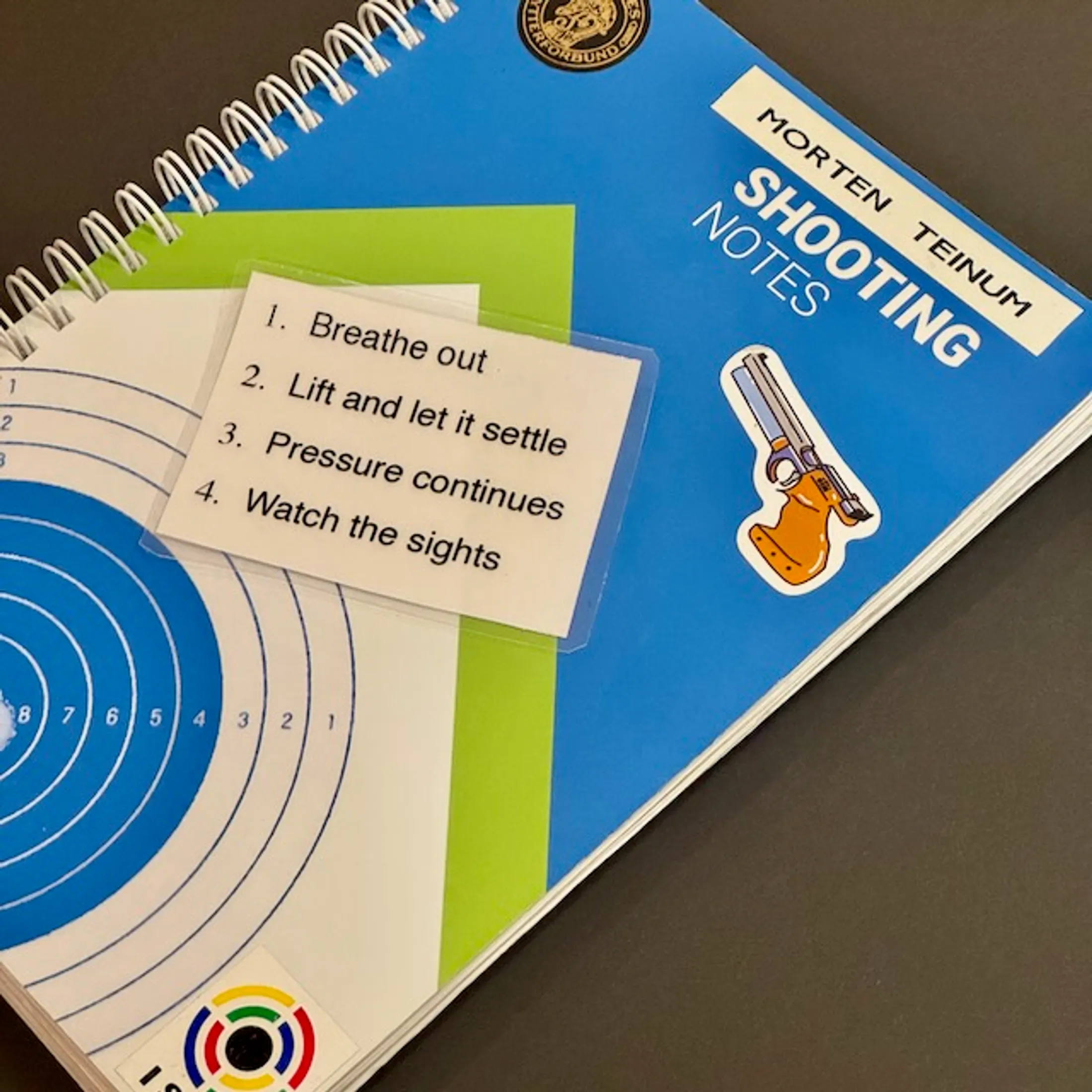
Many shooters are told they “need a shot plan” — but few are ever shown what that actually means.
A shot plan is not a checklist. It is not a long paragraph. And it is not something you think through while aiming.
A shot plan is a short, repeatable sequence that guides every shot — especially when pressure, emotion, or distraction would otherwise take over.
This article explains what a shot plan is, why it matters, and how to write one in 3–5 clear steps.
What is a shot plan?
A shot plan is a predefined execution script for one shot.
It tells you:
- what to do
- in what order
- without needing decisions in the moment
Think of it as rails for your attention.
When the shot starts, you don’t improvise — you follow the plan.
A good shot plan:
- is short
- uses simple language
- stays the same from shot to shot
- works in both training and competition
Why shooters struggle without a shot plan
Without a shot plan, shooters rely on:
- feeling
- judgment
- timing decisions
- last-second corrections
That works sometimes — until pressure increases.
Under stress:
- attention narrows
- decisions slow down
- emotions leak into execution
This is when shooters:
- rush good sight pictures
- hesitate too long
- force shots
- abandon technique
A shot plan prevents this by removing decisions.
What a shot plan is not
Before writing one, it helps to clear up common misunderstandings.
A shot plan is not:
- a description of perfect technique
- a reminder of everything you know
- a list of things to fix
- something you change shot to shot
If your plan is long, complex, or technical — it will fail under pressure.
The 3–5 step rule (and why it matters)
Your shot plan should have no more than 3–5 steps.
Why?
Because under pressure, the brain can reliably manage only a few simple cues.
More than that, and the plan collapses.
Each step should:
- be observable
- be controllable
- move the shot forward
If a step doesn’t meet those criteria, remove it.
How to write your shot plan (step by step)
Here is a simple structure that works for most precision pistol shooters.
Step 1: Preparation
This step happens before lifting the pistol.
Examples:
- “Grip set and balanced”
- “Breath out”
- “Commit to process”
Purpose: To start the shot deliberately, not reactively.
Step 2: Lift and settle
This step covers bringing the pistol up and letting it settle into the aiming area.
Examples:
- “Lift smoothly”
- “Let the sights settle”
- “Accept movement”
Purpose: To avoid rushing or forcing stability.
Step 3: Trigger pressure
This is the core execution phase.
Examples:
- “Pressure starts early”
- “Pressure continues”
- “No stopping”
Purpose: To make the trigger a process, not a decision.
Step 4: Follow-through
This step happens after the shot breaks.
Examples:
- “Stay”
- “Pressure through”
- “Watch the sights”
Purpose: To prevent collapse and reinforce complete execution.
Optional Step 5: Reset
Some shooters benefit from an explicit reset step.
Examples:
- “Step back”
- “Breathe”
- “Next shot is new”
Purpose: To prevent carryover from the previous shot.
Example of a complete 4-step shot plan
Here is what a finished plan might look like:
- Grip set, breathe out
- Lift and let it settle
- Pressure continues
- Stay through the shot
That’s it.
Short. Clear. Repeatable.
How to use your shot plan in training
A shot plan only works if it is used every time.
In training:
- say the steps quietly to yourself
- do not add extra thoughts
- do not modify the plan mid-shot
If a shot fails, you don’t fix it during execution.
You return to Step 1 on the next shot.
How a shot plan helps under pressure
Under match stress, shooters often try to “focus harder”.
A shot plan removes the need for that.
Instead of asking:
“Is this good enough?”
You simply ask:
“Am I still in the plan?”
If yes → continue.
If no → abort.
That simplicity is why shot plans work.
Common mistakes when writing a shot plan
Avoid these:
- Writing technical instructions (“align sights perfectly”)
- Including outcome goals (“shoot a 10”)
- Changing the plan after bad shots
- Adding steps over time
A shot plan should get simpler, not more detailed, as you improve.
From a coach
This was a question from the Coaching Discussion on youtube with Dr. Željko Todorović.
David Banks
I guess my one question would be: I work with junior shooters 90% of the time. What would be your best advice for me to give to them?
Dr. Željko Todorović
Probably what I said before: try to teach them both things — technical skills and mental skills — at the same time. Don’t let them fire a single shot before they do a mental rehearsal of that shot.
If you ask me about the technical aspect, that’s what I understand as the key point. Because when it comes to a match at the Olympics — the Olympic final — if I may take that as the crown example, the most difficult moment…
What I demanded from my athletes who have been there is basically this:
You have a loop that starts on day one. When a shooter walks through the door, you give them the instruction on how to become an Olympic champion. You tell them: align the sights in accordance with the target, and gently squeeze the trigger. And then comes the adventure: the next 10 or 15 years of a bumpy road.
Then, when they return back to the basic information, the basic instruction, they shoot the Olympic final successfully. Because that’s all that matters. That’s what they are doing when they shoot for Olympic gold: they focus on the very basics.
In order to be prepared for that journey, you really have to implant, from day one, into every single shot of their routine, that no shot can be fired before it is prepared.
Final takeaway
A shot plan is not about control. It is about clarity.
When execution has a clear structure:
- pressure has less influence
- mistakes don’t multiply
- consistency improves naturally
You don’t need a better plan under pressure.
You need the same plan you trust in training.
Write it once. Practice it daily. Let it carry you when thinking no longer helps.