
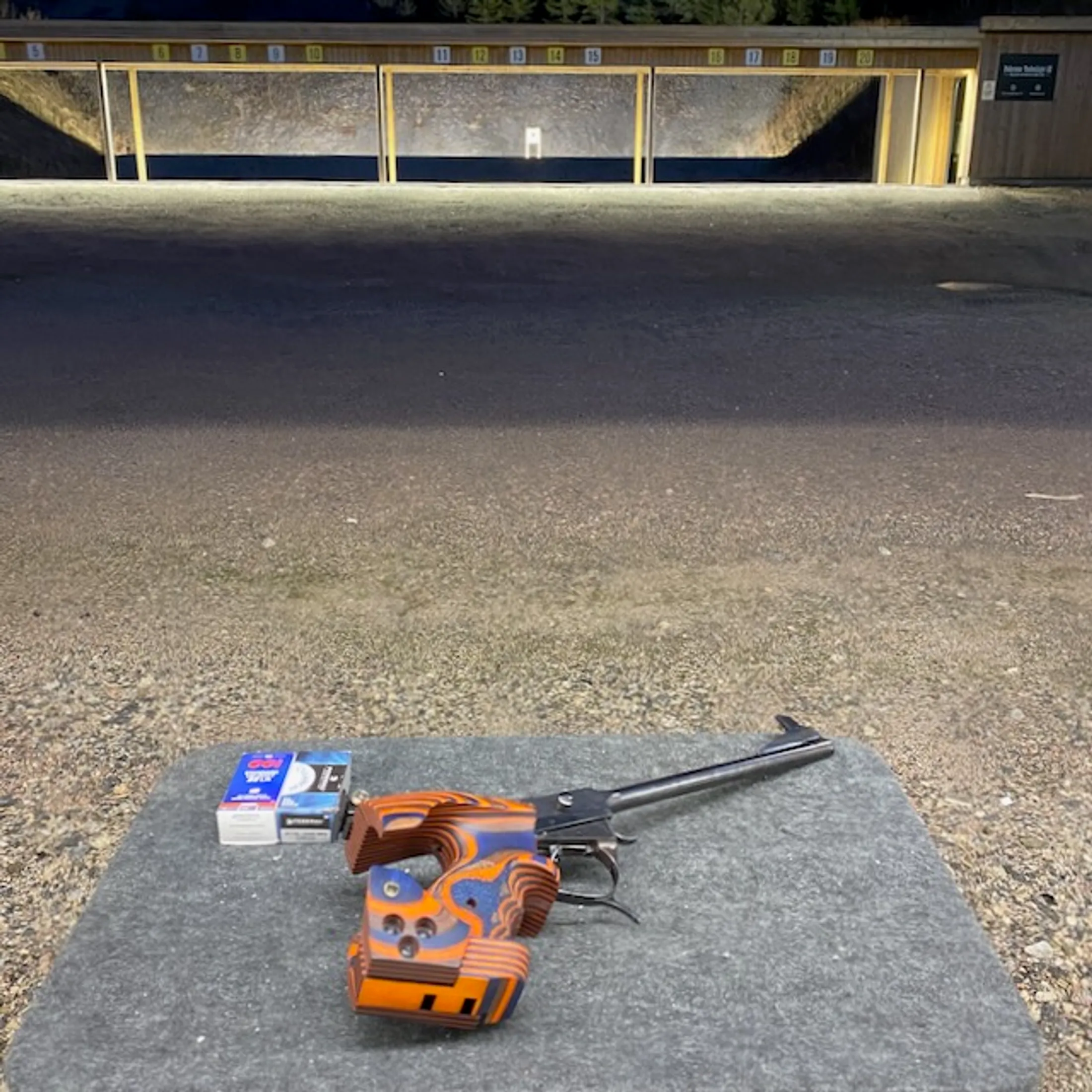


One of the most common technical questions in precision shooting is about trigger speed.
Shooters ask:
- “Am I pulling too slowly?”
- “Should I speed it up?”
- “Is my trigger too cautious?”
The problem is not that the question is wrong —
it’s that it points attention in the wrong direction.
Why “slow or fast” leads to problems
Trigger speed sounds measurable and controllable, so it feels like a useful concept.
In practice, thinking about speed causes shooters to:
- hesitate
- rush
- start and stop pressure
- wait for perfect sight pictures
All of these interrupt execution.
A trigger that is consciously sped up or slowed down is no longer part of a process — it becomes a decision.
What actually matters: continuity
Good trigger control is not defined by speed.
It is defined by uninterrupted pressure.
When pressure:
- starts early
- increases smoothly
- never pauses
…the shot will break at the correct moment without timing.
Speed then becomes a result, not a goal.
Why continuity solves both rushing and hesitation
Rushing and hesitation are opposites — but they share the same cause.
Both happen when the shooter:
- waits for a visual signal
- then decides to fire
That decision point is where errors occur.
Continuous pressure removes the decision entirely:
- there is no “now”
- there is no “not yet”
- there is only continuation
The shot breaks because pressure reached the release point — not because the shooter chose the moment.
How trigger speed changes naturally
When pressure is continuous:
- a stable hold produces a slower-looking release
- a less stable hold produces a faster-looking release
This is adaptive, not faulty.
Trying to force a fixed speed removes that adaptability and creates tension.
Elite shooters do not aim for a specific trigger speed. They aim for no interruption.
Continuity inside a shot plan
This is where trigger control connects directly to the shot plan.
In a typical shot plan:
- early steps are about preparation and control
- the trigger step is about starting and continuing pressure
- later steps are about follow-through and reset
The trigger phase is not where you evaluate. It is where you commit to continuity.
If pressure stops, the plan is broken — and the shot should be aborted.
A simple way to train continuity
In both dry fire and live fire, use this rule:
If trigger pressure stops, abort the shot.
This immediately:
- removes hesitation
- prevents rushing
- clarifies feedback
It also makes problems visible:
- freezing becomes obvious
- over-aiming reveals itself
- forced shots disappear
Common mistakes when focusing on trigger speed
Avoid these traps:
- “I’ll pull faster when it looks good”
- “I need to slow down the trigger”
- “I rushed that one, so I’ll be careful”
All of these add conscious timing — and reduce precision.
Replace them with:
“Pressure continues.”
What to take to the range
If trigger control feels inconsistent, stop asking how fast it should be.
Ask instead:
- Does pressure start early?
- Does it ever stop?
- Do I abort when it does?
If pressure is continuous, timing solves itself.
Final takeaway
Trigger speed is an outcome, not a skill.
You don’t pull the trigger at the right moment.
You let the moment arrive while pressure continues.
When continuity replaces timing, trigger control becomes calm, adaptable, and reliable.
References & Coaching Background
The principle of continuous trigger pressure is consistently emphasized across elite pistol shooting literature and motor learning research.
Olympic & ISSF Shooting Literature
-
The Fundamentals of Olympic Pistol Shooting – Željko Todorović
Describes trigger release as the result of uninterrupted pressure rather than consciously timed action. -
Competitive Shooting – A. A. Yuryev
Analyzes how trigger hesitation and forced release disturb sight alignment and shot stability. -
The Vital Problems of Pistol Shooting – Anatoliy Piddubnyy
Explains the neuromuscular consequences of stopping and restarting trigger pressure. -
Master Competitive Pistol Shooting – Ragnar Skanåker
Emphasizes trigger continuity as a foundation of repeatable execution.
Motor Learning & Sport Psychology
-
R. S. W. Masters – Knowledge, Knerves and Know-How
Shows how conscious timing disrupts automated motor skills under pressure. -
Competitive Sport Shooting: Practical Sport Psychology (ISSF)
Highlights continuity and process focus as key to stable execution in competition.
If you’re thinking about trigger speed,
you’re already too late.