
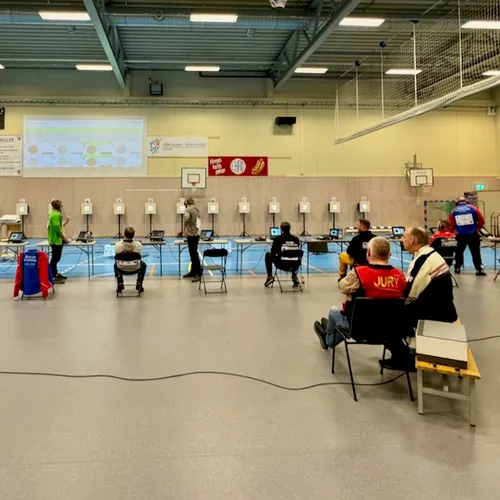


Many shooters recognize the pattern immediately.
They shoot well alone.
They shoot well in normal training.
But as soon as someone watches—coach, teammates, spectators—their shooting changes.
This is not a confidence issue.
It is a focus shift.
What actually changes when people watch
When no one is watching, attention stays on execution:
- grip and balance
- sight movement
- trigger pressure
- the shot plan
When people watch, attention moves outward:
- how you look
- how you’re judged
- what others might think
- whether the shot “counts”
The body responds instantly:
- tension rises
- timing changes
- trigger continuity breaks
Nothing technical has changed.
Attention has.
From doing to being seen
Performance drops when attention shifts from doing the task to being observed doing the task.
Instead of running the shot plan, the shooter starts to:
- monitor themselves
- protect their image
- avoid visible mistakes
- think about outcomes
The shot becomes a performance rather than an execution.
Why this doesn’t disappear with confidence
Many shooters believe:
“Once I’m confident enough, this won’t bother me.”
But confidence built in private does not automatically transfer to public execution.
Visibility introduces a different demand.
That’s why shooters can:
- train well
- qualify well
- struggle in matches or finals
They are technically ready—but not trained for visibility.
Pressure is a skill, not a flaw
Being watched is a form of pressure.
And pressure is trainable.
Just like trigger control or balance, tolerance to visibility improves with progressive exposure.
Avoiding it keeps it unfamiliar.
Training it makes it normal.
How to train visibility on purpose
You don’t need finals crowds to do this.
Start small:
- shoot with one person quietly behind you
- film a training session
- announce your score before checking it
- follow full match routines even when training alone
The goal is not comfort.
The goal is familiarity.
What must stay the same under observation
The solution is not more focus or effort.
It is unchanged structure.
When people watch:
- the shot plan stays the same
- the reset stays the same
- the breath stays the same
- the pace stays the same
If execution changes because of observers, the structure was not stable enough yet.
Visibility inside the shot plan
A clear shot plan protects execution when attention is pulled outward.
The plan answers:
- what to do next
- where attention belongs
- when decisions are finished
When the plan runs, there is no space left for:
“What do they think?”
A simple match-day rule
Carry this into competition:
If being watched changes how you shoot, your focus left the process.
The correction is not mental force.
It is returning to structure.
What to take to the range
If shooting worse under observation is a problem:
- introduce visibility gradually in training
- keep routines identical
- resist explaining or justifying shots
- train “normal execution” while being seen
Over time, visibility stops being special.
Final takeaway
Shooting worse when watched is not weakness.
It is untrained exposure.
Execution comes from doing.
Pressure comes from being seen.
Both can be trained.
When visibility becomes familiar, performance returns to where it belongs.
References & Coaching Background
The effect of observation on performance is well documented in both shooting literature and sport psychology.
-
Željko Todorović
The Fundamentals of Olympic Pistol Shooting.
Emphasizes identical routines and unchanged execution regardless of external pressure. -
A. A. Yuryev
Competitive Shooting.
Describes how audience awareness and emotional carryover disrupt series stability. -
J. P. O’Connor
On the Firing Line.
Discusses outcome awareness and self-monitoring under competitive conditions. -
Sian Beilock
Choking Under Pressure.
Explains how self-focus under observation interferes with automated motor skills. -
ISSF – Competitive Sport Shooting: Practical Sport Psychology
Identifies exposure to pressure and visibility as core components of match readiness.
You don’t need people to stop watching.
You need execution that doesn’t change when they do.