
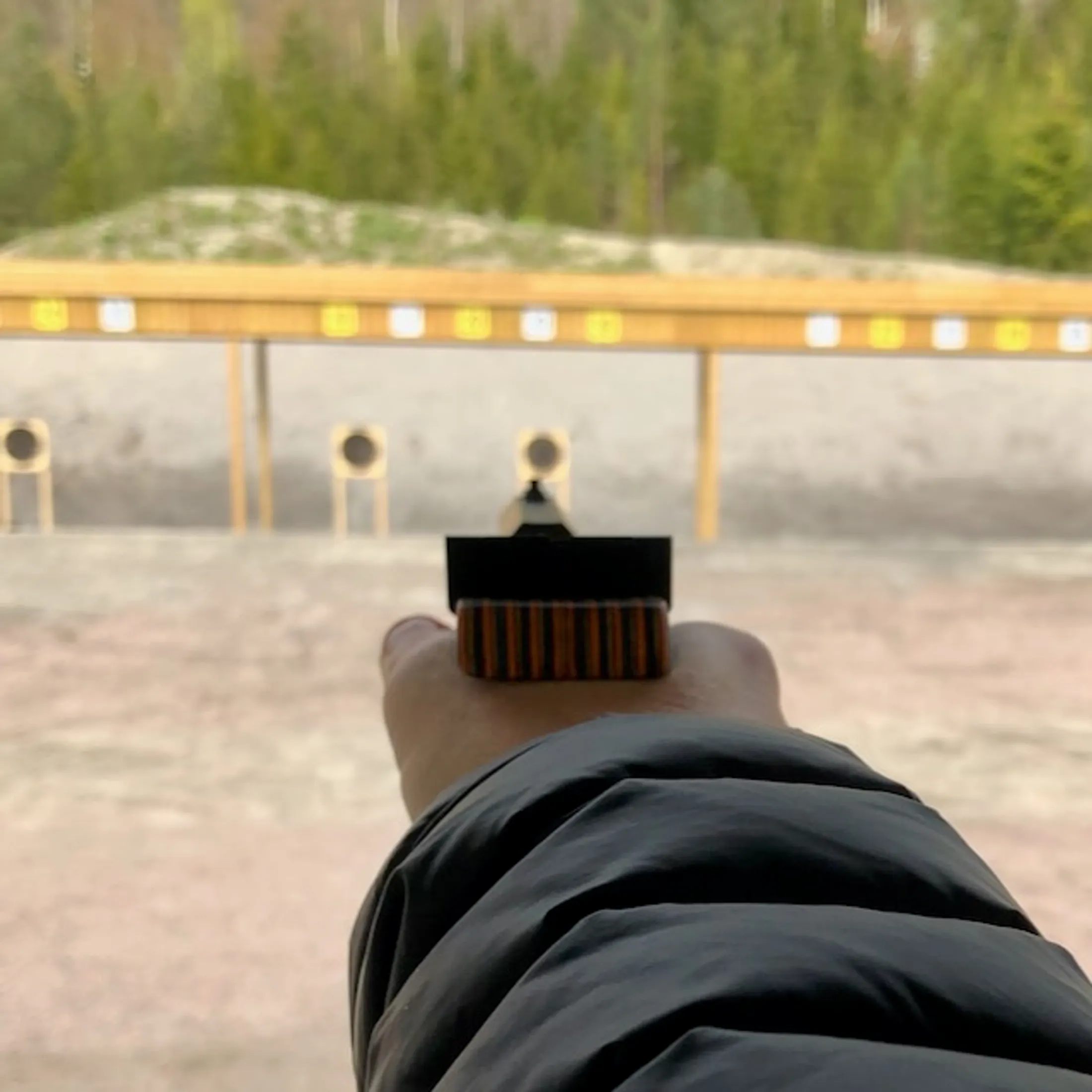


Many shooters believe that stability means eliminating movement.
So when the pistol starts to shake, they assume something is wrong:
- weak strength
- poor technique
- bad nerves
- lack of focus
In reality, the shaking usually starts because the shooter is trying to hold still.
Why trying to hold still creates shaking
The human body is not designed to be motionless.
When you try to freeze the pistol:
- muscles co-contract unnecessarily
- small stabilizers fight each other
- breathing becomes restricted
- attention narrows toward control
This creates tension — and tension amplifies movement.
The result feels like instability, even though the body is working harder than necessary.
The illusion of perfect stillness
Elite shooters do not shoot from a perfectly still hold.
They shoot from a controlled area of movement.
This movement:
- is small
- is predictable
- stays within a familiar zone
- does not require correction
Trying to remove it entirely forces the body into a state it cannot sustain.
Acceptance versus control
There is an important difference between:
- accepting movement
- controlling movement
Accepting movement means:
- allowing natural sway
- observing without reacting
- continuing trigger pressure despite motion
Controlling movement means:
- tightening muscles
- chasing stillness
- interrupting pressure
- reacting to every deviation
Only the first leads to calm execution.
Why calm shooters look steadier
Calm shooters are not steadier because they move less.
They look steadier because they:
- do not fight movement
- do not react to it
- do not judge it mid-shot
Their attention stays on the process, not on suppressing motion.
How this fits into the shot plan
This is where movement acceptance belongs structurally.
In a clear shot plan:
- preparation sets balance and grip
- lift allows the pistol to settle
- aiming accepts movement
- trigger pressure continues regardless
The mistake happens when shooters insert an extra step:
“Now I must hold it still.”
That step does not belong — and it breaks the plan.
A simple mental shift that helps immediately
Replace this thought:
“I need to stop the movement.”
With this one:
“This is my movement.”
Nothing else changes.
Trigger pressure continues. Observation replaces intervention.
Why this feels uncomfortable at first
Accepting movement can feel like giving up control.
In reality, it is choosing the right kind of control:
- control of preparation
- control of process
- not control of micro-movement
The discomfort fades as the shooter learns that shots break cleanly inside motion.
What to take to the range
If shaking appears when you try to hold still, train this deliberately:
- Allow movement during aiming
- Start trigger pressure earlier
- Do not wait for the movement to disappear
- Abort only when structure breaks — not because motion exists
Over time, movement becomes quieter — not because it was forced away, but because tension disappeared.
Final takeaway
Shaking is rarely the problem.
Fighting movement is.
Stillness is not the goal.
Stability is.
Calm shooters do not eliminate motion.
They learn to work inside it.
References & Coaching Background
The principle of movement acceptance is well established in elite pistol shooting and motor control research.
Olympic & ISSF Shooting Literature
-
The Fundamentals of Olympic Pistol Shooting – Željko Todorović
Describes aiming as working within a natural movement area rather than attempting to suppress it. -
Competitive Shooting – A. A. Yuryev
Explains how excessive muscular control increases tremor and disrupts coordination. -
Front Sight – Marco Masetti
Emphasizes visual acceptance and non-interference during aiming.
Motor Control & Sport Psychology
-
Anatoliy Piddubnyy – The Vital Problems of Pistol Shooting
Analyzes how co-contraction and tension increase instability during precision tasks. -
Sian Beilock – Choking Under Pressure
Shows how conscious control of automatic processes amplifies instability and error.
Movement is normal.
Tension is optional.